
Audience research
Part of When to rebuild AI content operations audience research
How to run customer interviews for AI content operations
A practical guide to customer interviews for AI content operations, from choosing participants and questions to handling notes and applying findings.
What to take away
- A Leeds team planning a chatbot for its help centre learns more from six support-agent interviews than from a tool demo.
- Treat interviews as evidence, not a vote. One angry account should not reset your roadmap.
- Inclusion criteria matter more than sample size. Decide who counts as a customer before you book anyone.
- Record consent, purpose and retention when you book, because AI-assisted notes create personal data.
- Write the findings into your AI content operationsaudience research guide for England so the evidence survives staff changes.
Start with the decision the interviews must inform
A vague brief produces vague transcripts. Before booking anyone, write one sentence naming the decision. For example, a Manchester retailer might need to decide whether AI drafts delivery-complaint replies or only suggests them for a human.
Decision Before Booking
What decision must interviews inform?
write one sentence, set criteria
vague brief, vague transcripts
That sentence sets your inclusion criteria. You want people who raised a delivery complaint in the last quarter, not anyone who has ever bought something. If the workflow touches customers in Scotland, include at least one Scottish participant, because expectations of redress can differ.
Pick participants on criteria, not enthusiasm
Set three filters and apply them consistently: recency, role and variation. Recency means the person used the service within a defined window. Role means they experienced the problem you are automating. Variation means including people who succeeded and people who gave up.
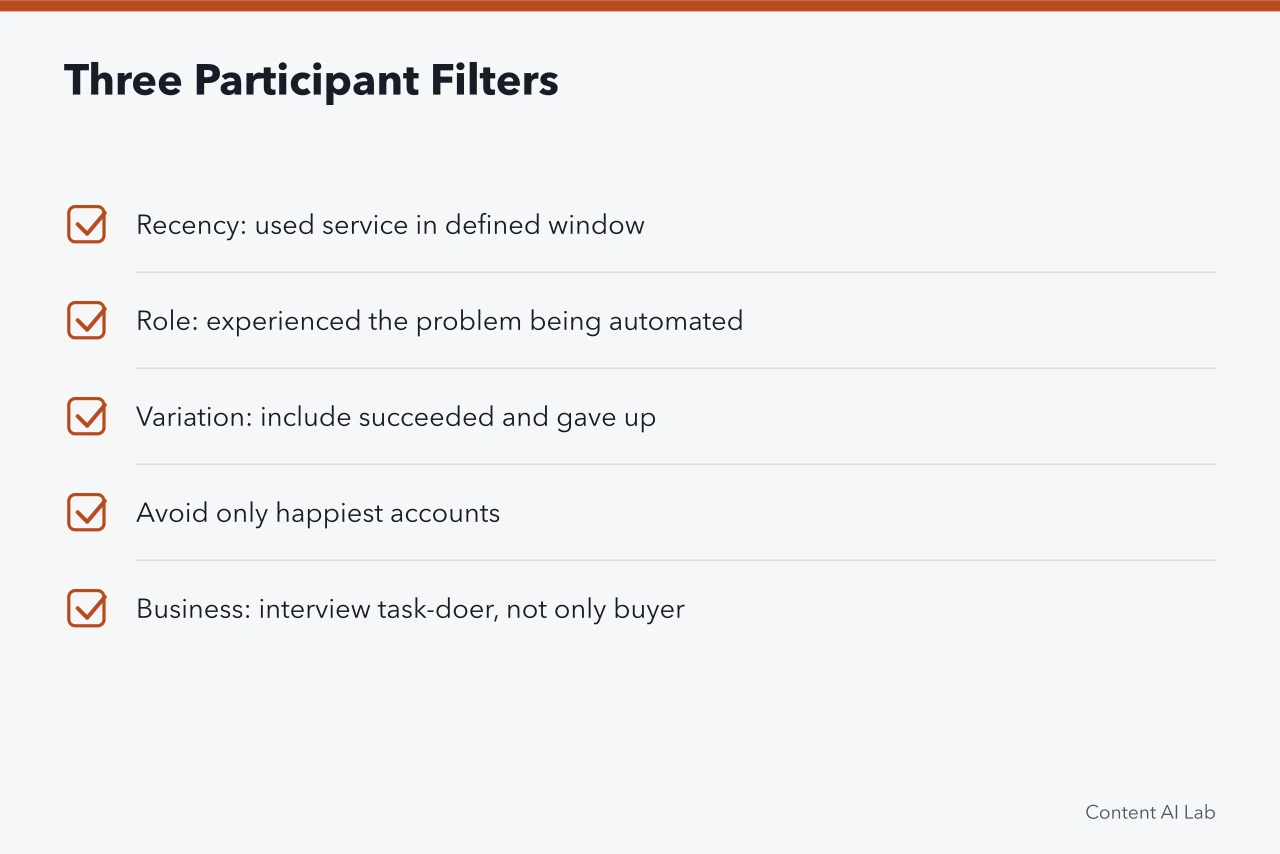
Avoid recruiting only your happiest accounts, because review-site fans flatter any AI pilot. If you sell to businesses, interview the person who does the task, not only the buyer who signs the contract.
Ask about past behaviour, not future intent
People are poor at predicting what they will accept from a machine. Ask what happened last time, which channel they used, what they wrote and what they did when no reply arrived.
Then ask what would have made them trust an automated reply. Listen for specifics such as a named sender, a reference number or an escalation route. Those details become requirements.
Handle transparency and data protection properly
If AI tools summarise or tag interview notes, you are processing personal data. The ICO's guidance on explaining decisions made with artificial intelligence sets out what a meaningful explanation looks like when a participant asks how their words will be used.
The ICO's data protection explanation states that the UK data protection regime is the UK GDPR and Data Protection Act 2018 (DPA 2018), with PECR sitting alongside it.
Say whether a model will transcribe the call, where the recording sits and when it is deleted. Get consent in writing before recording, and delete the file if a participant withdraws.
Map findings to the rules that apply
Interview evidence often points to a compliance question. If your automated replies make decisions about people, you need a lawful basis and a route to human review. The government's AI regulation: a pro-innovation approach paper explains the cross-sector principles regulators are expected to apply, useful when briefing a legal team.
Consumer protection, data protection and equality duties apply across the UK. Where a rule differs in Scotland, Wales or Northern Ireland, note it in the same document.
Choose tooling after the evidence, not before
Once you know what participants need, compare platforms against those needs. Vendor documentation is a sensible starting point: Microsoft's Azure AI services documentation describes the language, speech and translation capabilities available, so you can check whether a feature exists before a sales call claims it does.
Score each option against your interview findings. A tool that cannot log who approved a draft will fail a team that called human sign-off non-negotiable.
Write it up so it stays useful
Summarise each interview on one page: who they are, what they did, what they said, what it implies. Tag quotes by theme so you can count how often a problem appears. Then fold the themes into your AI content operations target audience in England work so segment definitions and interview evidence sit together.
Glossary
- Inclusion criteriathe rules deciding who may take part.
- Consenta freely given, specific agreement to take part and be recorded.
- Human reviewa person checking an automated output before it reaches a customer.
- Themea pattern appearing across several interviews.
Common questions
How many interviews are enough?
Enough to hear the same problems repeated without new themes appearing. Six to ten well-chosen participants usually reach that point.
Can I use AI to analyse the transcripts?
Yes, provided you have a lawful basis and have told participants. Check the summary against a sample of transcripts and record who approved the output.
Do I need to pay participants?
There is no legal requirement. A voucher is common practice and improves turnout, but check your organisation's expenses policy first.
Does this work for Welsh or Scottish customers?
Yes, but add participants from those nations, because service expectations and complaint routes can differ.