
Outlook
Part of Budget for the AI content operations outlook before you renew licences
Why AI content operations risk scenarios deserve a place in your planning
AI content operations risk scenarios help teams rehearse pricing claims, consent and labelling failures before a regulator or a customer spots them.
What to take away
- The Digital Markets, Competition and Consumers Act 2024 received Royal Assent on 24 May 2024. Its consumer protection and subscription provisions are not live on Royal Assent; they commence by regulation, so check the commencement regulations for the date they apply.
- Most failures in AI-assisted publishing trace back to a workflow gap, such as an unclear brief or a claim nobody owns, rather than the model itself.
- Write each scenario as a trigger, an owner and a rehearsed response, so nobody debates roles during an incident.
- Reopen the list when guidance or platform rules change, not only at annual planning.
Why a risk register is not enough
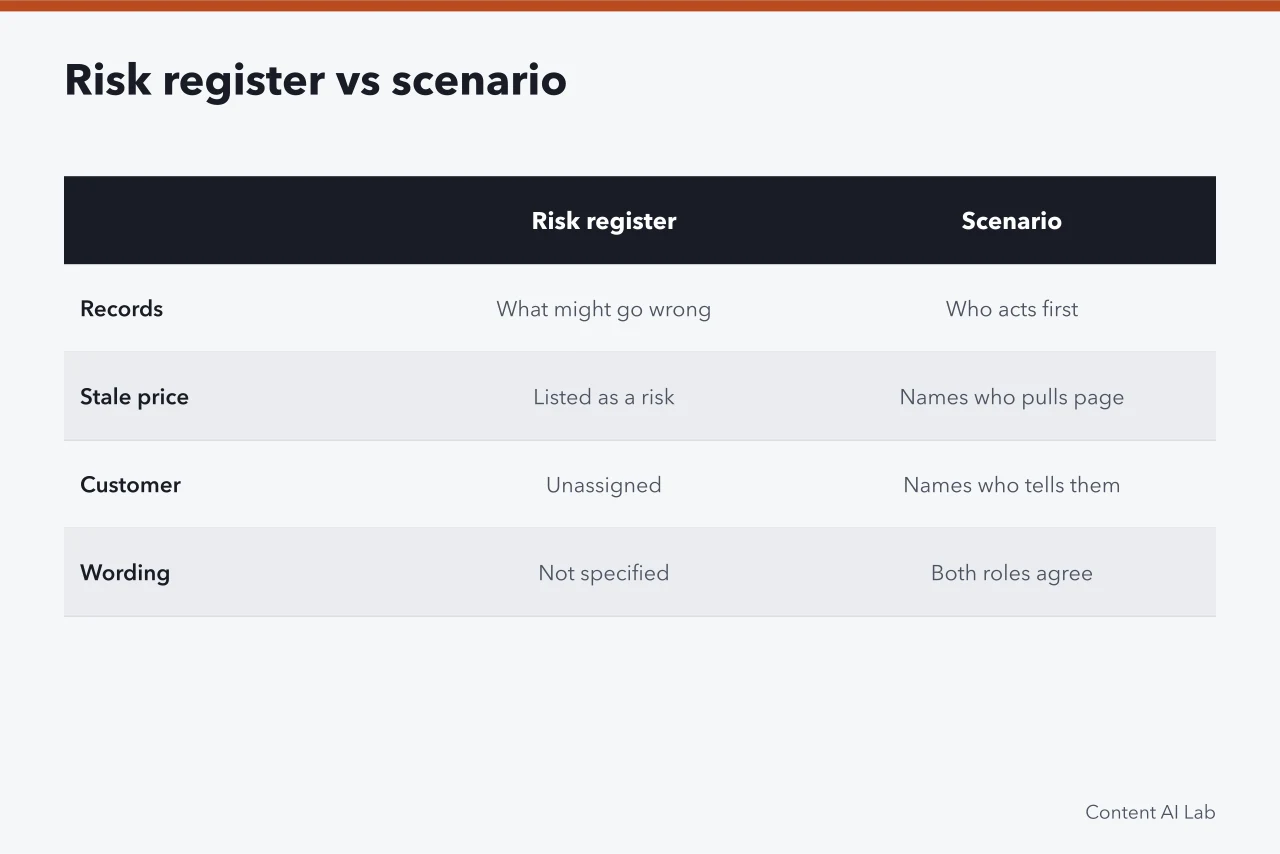
A risk register records what might go wrong. It rarely says who acts first. Scenarios do. If a generated page publishes a stale price on a Saturday, the useful document names who pulls the page. It also names who tells the customer and the wording both would use.
Content path and handoffs
- Briefrisk notes attach here
- Draftassistant output, add check
- Editreviewer verifies claims
- Publishpage goes live
- Retirepage taken down
- Handoffslosses sit between teams
Walk the content path before you write anything
List the steps a page passes through: brief, draft, edit, publish and retire. Risks attach to steps rather than to tools. That mapping also shows where an assistant saves time and where it adds a check.
Map the handoffs as well as the steps. Most losses sit at the join between two teams, where nobody assumes the page is still live.
Teams that treat this as a live discipline rather than a one-off audit tend to spot problems earlier. The wider AI content operations trends and outlook explains why the pace of change makes that habit worth building.
Write each scenario as trigger, owner, response
A trigger is observable: a complaint, a regulator email, a spike in refund requests. The owner is one named role, not a committee. Use the pricing owner for price claims, the consent owner for lists and the native labelling owner for paid placements. The response is three or four steps written in advance, short enough to follow while tired.
Keep the register to about a dozen scenarios. Start with these twelve:
- Stale price on a generated product page.
- Unsupported comparative claim in a buying guide.
- Consent lapse in an outbound sequence.
- Missing native label in a paid feed.
- Broken syndication disclosure.
- Unchecked AI-generated testimonial.
- Competitor trademark in generated copy.
- Wrong currency or unit in a price.
- Accessibility failure in a generated page.
- Serious complaint alleging misleading copy.
- Regulator email about subscription terms.
- Platform policy change affecting labelling.
Risk scenarios worth scripting now
Claims, prices and subscription copy
Generated copy tends to overstate. It rounds a price, invents a superlative or implies free cancellation. Under UK consumer protection rules, the trader carries the liability whatever tool produced the words. Script the check: every number verified against a source, every comparative claim signed off by someone senior.
Decide in advance who can approve a price change, and how quickly the page comes down if the approval was wrong.
A useful test is to ask whether the sentence would survive being read aloud to a customer who then asked for evidence. If not, it needs a reviewer, not a rewrite.
Outbound marketing and consent
Email and messaging carry separate duties. The ICO guidance on direct marketing and electronic communications sets out consent and soft opt-in conditions. A generated nurture sequence does not inherit consent just because a human approved the subject line. Keep a record of the lawful basis for each list before the copy is written.
Segment lists by when and how consent was captured, because a generated sequence can run across several campaigns.
Worked example: consent lapse in a generated nurture sequence
- Triggera list audit finds a segment captured through a legacy competition entry route with no opt-in wording.
- Ownerconsent owner, with the data protection lead.
- Responsepause the sequence within one working day; isolate the segment; confirm the lawful basis; re-permission or suppress the list; log the fix and review the source rules.
Format, channel and update triggers
Rule changes arrive through formats, channels and platform terms, so track each trigger against the scenario it affects.
Format and channel changes
Native and paid placements add their own expectations. The IAB UK principles for native distribution creative best practice treat clear labelling and honest creative as baseline conditions. That matters when generated copy travels into feeds where readers see no editor's note. Add a scenario for every format you buy or syndicate.
Add a scenario for each syndication partner, since their labelling rules may be stricter than yours.
What changes once scenarios exist
Before scenarios
- Brief
- One line, no risk notes
- Draft
- Model output edited for tone
- Approval
- Slack thumbs up
- Publication
- Publish and move on
- Correction
- Ad hoc edit
After scenarios
- Brief
- Named claims, sources and reviewer
- Draft
- Facts checked against a source list
- Approval
- Recorded sign-off with a date
- Publication
- Logged and monitored for two weeks
- Correction
- Documented fix with a review note
For example, a team paying £400 a month for a content platform can still lose more from one stale pricing page than from a year of licences. Scenarios keep spending in proportion to the damage a mistake would cause.
Common questions
Who should own AI content operations risk scenarios?
One named owner per scenario, usually the person who would make the first call. A content lead can hold the register, but the marketing, legal or product owner signs off the response steps. Skills matter here, and the AI content operations skills forecast in England maps the capabilities employers are hiring for.
How often should the list be reviewed?
Twice a year is enough for the core list. Add event triggers: new guidance from a regulator, a platform policy change, a serious complaint or a new market launch. An unused scenario is cheaper than an unplanned incident.
Can a small team run this without extra headcount?
Yes, if each scenario has a named owner and a rehearsed response. Start with claims and consent, then add channel-specific scenarios as you expand.