

Operations
Part of How to create an AI content style guide for UK brands
How to create an AI content style guide for UK brands
Create an AI content style guide for UK brands: British spelling rules, tone-of-voice examples and prompt blocks that keep AI drafts on brand.
What to take away
- An AI content style guide is the rulebook your team pastes into prompts, not a document that sits unread in a shared drive.
- It has two halvesmechanics, covering spelling, punctuation and numbers, and voice, covering how the brand sounds.
- Fixing the language rules against a published authority stops editors and tools disagreeing about the same sentence.
- Rules that fit on two pages get followed; longer ones get skimmed.
- Review the guide every quarter, and after any change of model or tool.
Decide which English you write
Models trained mostly on American text default to American spellings and to punctuation that reads oddly in the UK. Left alone, a draft will drift within a few hundred words.
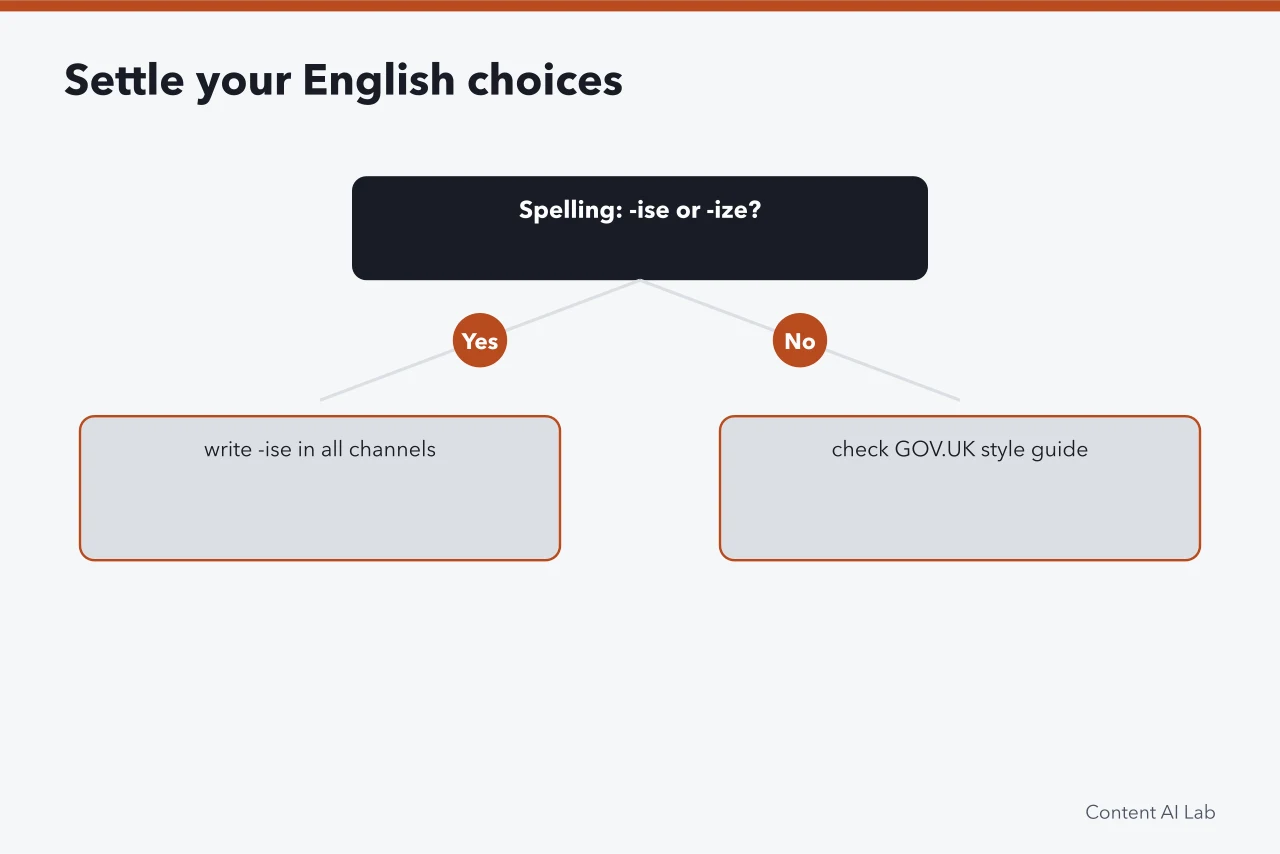
Write down the choices your house style makes: -ise or -ize endings, single or double quotation marks, and date formats. Where you have no strong preference, borrow from the GOV.UK style guide, which is free and written for plain English.
Keep the Oxford style guide for anything GOV.UK leaves open, such as serial commas or job titles. Say which source wins when they disagree, or the model will choose at random. Public bodies sometimes layer their own house rules on top, so check before borrowing one wholesale.
Write the voice section with paired examples
Tone of voice is where AI drafts fail most visibly. Models default to a cheerful, neutral register that could belong to any company in any sector.
Voice: on-brand vs off-brand
On brand
- Costs
- Tell you the cost
- Evidence
- Real sentences
- Register
- Specific, plain
- Volume
- Three pairs
Off brand
- Costs
- Passionate about value
- Evidence
- Invented adjectives
- Register
- Cheerful, neutral
- Volume
- A page of prose
Give the model evidence rather than adjectives. For a professional services brand, 'We will tell you what the work costs before we start' shows the voice; 'We are passionate about delivering value' breaks it. The second sentence is what a model writes when nobody stops it.
Three paired examples carry more weight than a page of description. Put them in a two-column table so editors can check drafts against each rule.
Build the guide in six steps
- Collect ten published pieces the team is happy with and note the patterns they share.
- Write the mechanics rules first, one line each, with an example and a counter-example.
- Add voice pairs taken from real sentences, not invented ones.
- List banned words, including filler that models reach for by default.
- Set a claims rule for marketing copy. The advertising codes require evidence for anything stated as fact, so statistics need a named source and a date.
- Publish the guide as one markdown file your team can paste into a prompt, and version it.
A decision table for the rules you must settle
Most disagreements about AI drafts come down to a handful of recurring decisions. Settle them once in a table, with the chosen option marked, and reference it in every brief.
| Decision | Options | House rule |
|---|---|---|
| Spelling | -ise or -ize | -ise in all channels |
| Quotation marks | single or double | double for speech, single inside |
| Numbers | figures or words | figures from 10 upwards |
| Dates | 4 March 2027 or 04/03/27 | 4 March 2027, no ordinal |
| Contractions | allowed or avoided | allowed in blog and social, avoided in policy pages |
| Acronyms | capitals or spelled out | spelled out on first use, then bracketed |
Put the guide into prompts and checks
A guide nobody pastes into a tool changes nothing. Keep the mechanics and voice rules in a single prompt block, and start every drafting session with it.
Keep the full guide in your workspace and link to it from the brief, rather than copying it into every prompt.
Add a checking step before publication. A human editor reads for meaning; a tool reads for style. A comparison of AI editing tools for UK English sets out what they catch and miss.
For larger teams, the guide belongs inside a wider assurance process. The AI Playbook for the UK government lists questions to ask about any AI-assisted output, including who checked it and where the source material came from. Record that check in the content management system so the trail survives staff changes.
Guides rot. A rule written for last year's model can push a current one into stilted phrasing, so diarise a quarterly read-through and note the date of the last revision on the first page. Anything unused for six months should go, because dead rules dilute live ones.
Version control matters as much as the rules. A maintained AI content prompt library keeps prompt blocks tagged by channel and review date, so nobody pastes an out-of-date block into a live brief.
Common questions
How long should an AI content style guide be?
Two to four pages is enough for most teams. Anything longer is usually reference material that belongs in an appendix.
Should the guide cover punctuation as well as spelling?
Yes. Spelling slips are the most visible failure in AI drafts, but date formats and heading capitalisation cause just as many corrections.
Do we need a separate version for each AI tool?
No. Keep one guide and adjust the prompt block, because tool-specific rules go stale quickly.
Who should own the guide?
An editor with publishing authority, not a marketing manager who writes occasionally. The owner approves changes and signs off the quarterly review.